Reflections from the studio — on painting, memory, and what the materials ask of the hand.
Work Note · 2026
Tōryanse — The Gate
通りゃんせ — 狐と鳥居
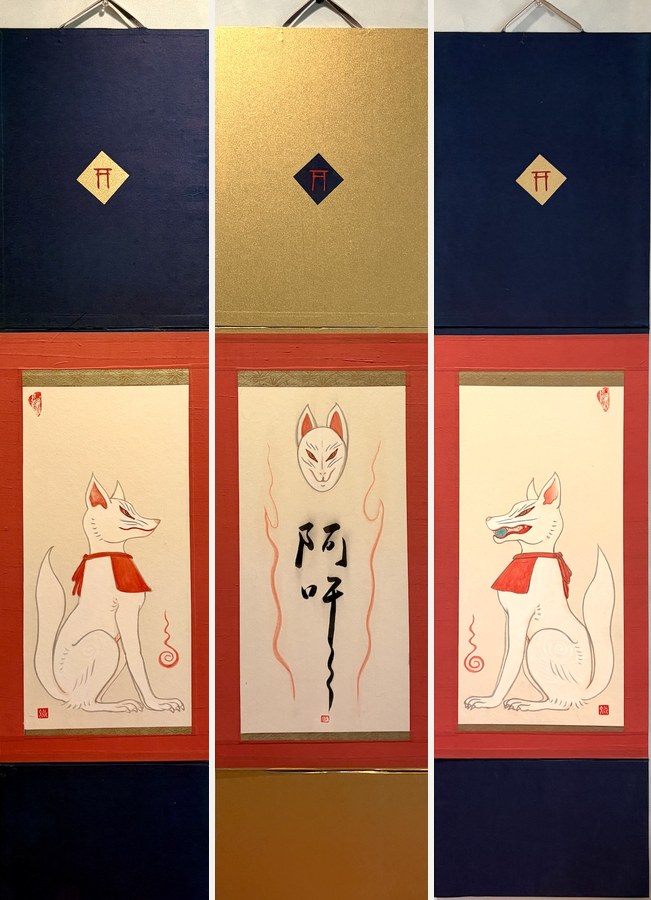
This triptych was created for Kitsune / Bewitched, an invitational exhibition organized by Priscilla Otani at Arc Gallery SF, San Francisco.
The work draws from childhood memories connected to visits to Fushimi Inari Taisha — the layered atmosphere of fox imagery, vermilion gates, ritual spaces, and stories carried quietly through memory.
The gate becomes both a physical and psychological passage — a space between memory and imagination, the visible and invisible, safety and uncertainty.
The title references the traditional Japanese children's song Tōryanse, associated with passing through a gate or crossing a threshold. The central scroll incorporates the phrase Ah-Un (阿吽) — paired opposites, breath, beginning and ending.
Rather than illustrating folklore directly, the fox appears as an ambiguous presence emerging through accumulated gesture, layering, and atmosphere. The spiral lines throughout are painted in hand-prepared gofun, a traditional white pigment made from aged oyster and scallop shells.
More broadly, the work connects to my ongoing interest in how encounters, memories, and unseen emotional traces become embedded within material surfaces over time.
Sumi ink, mineral pigments, gofun, coral, cinnabar, and gold on mashi (hemp paper) · Hanging scroll triptych · 22 × 20 in. each panel · scroll: 48 × 12 in. each · 2026
Work Note · 2026
Black Cat — It Knows
知るもの — 万葉の歌に寄せて
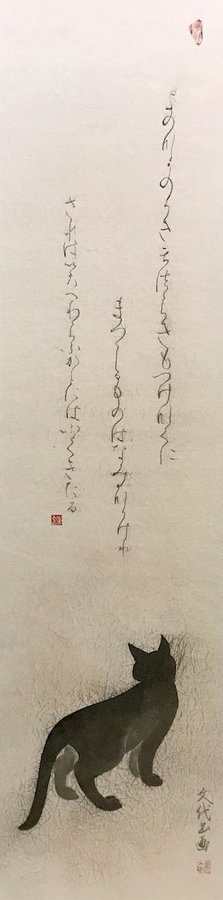
This painting is part of a diptych inspired by classical Japanese waka poetry from the Kokinshū, one of the earliest imperial anthologies of Japanese poetry. The work reflects on the subtle threshold between dreams and waking reality — an ambiguous space where emotions and intuition quietly arise before they become words.
The black cat embodies a quiet, intuitive awareness — an understanding that exists before language. In the accompanying poem, tears are described as the first to recognize sorrow in the world. Yet the work also carries a gentle affirmation drawn from a familiar Japanese saying: "Warau kado ni wa fuku kitaru" — Happiness comes to those who smile.
Is this world a dream, or is it real? Even that, we cannot truly know.
The companion piece, White Cat, reflects on this classical poem that questions the nature of reality itself. Together, the two works contemplate the uncertainty of a world that changes at a tremendous speed — suggesting that even within ambiguity, a small gesture such as a smile can open the door to grace.
The painting is created with sumi ink on Xuan paper, with touches of Nihonga pigments and gold, backed with unryu paper for texture and support.
Sumi ink, Nihonga pigments, gold on Xuan paper · backed with unryu paper · 2026
Featured in ART KALA 2026 Exhibition & Auction Benefit · Kala Gallery, Berkeley, CA · March 26 – April 25, 2026
Work Note · 2025
Vital Energy — From Hakubyo to Rebirth and Revival
生命のちから — 白描から復活と再生へ
In the practice of traditional Japanese painting, the 白描 (hakubyo) — a preparatory study rendered in ink alone — captures the essential gesture and structure of a work before any color is applied.
Often considered a private step in the artist's process, the hakubyo is also a complete work in its own right: the breath before the breath, the bones of what is to come.
Vital Energy began in the silence of ink. The white serpents — emblems of regeneration in many traditions — first appeared as line: contour without color, form without weight.
In the finished work, that quiet line is met with the warmth of pure gold and the depth of ground-mineral pigments — traditional materials of Nihonga. The composition holds the same gesture, but now resonates with breath.
The white serpent is an emblem of regeneration across many traditions. In Japanese culture it is associated with Benzaiten, the goddess of everything that flows — water, music, time, and fortune. To paint a serpent is to paint persistence: the shedding of one form and the emergence of another, continuous yet changed.
First exhibited in Between Worlds, Within Memories · two-person exhibition with Toru Sugita · Inclusion Gallery, San Francisco, 2025
Sumi ink, pure gold, Nihonga colors on wood panels · 48 × 12 in. each · 2025
Work Note · 2025
Into the Silver River
銀の川 — 輝きて 沫 まじわりて 銀の河
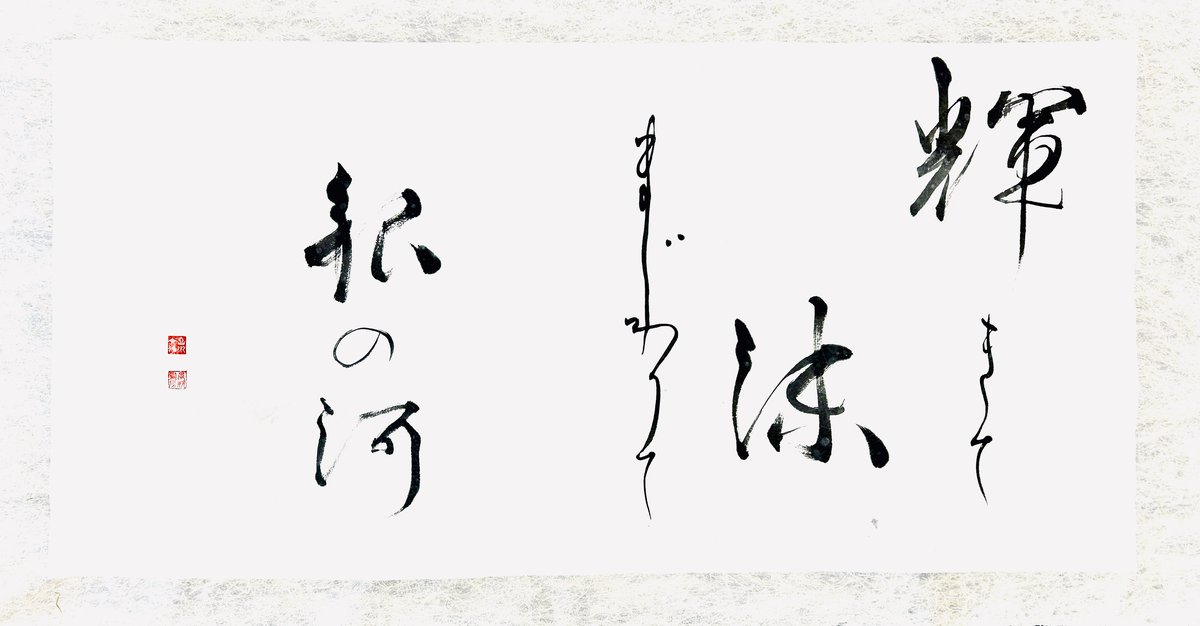
輝きて 沫 まじわりて 銀の河
Kagayakite — Awa — Majiwarite — Gin-no Kawa
Life is like a bubble. In the fleeting moment it leaps from the flow, it forms its own shape — shining, dancing — then merges once more into the great current, connecting with all things.
This world and the next will eventually become one, united in the vastness of the universe. All memories are shared, and all beings are connected by a great root. We are always flowing together, sometimes near, sometimes far — but never truly apart.
This large-scale calligraphy work came from a long period of sitting with this poem — feeling its movement in the body before placing any mark. The wide horizontal format of the paper became the river itself: the brushwork crosses the surface in a single sustained gesture, ink and silver moving together.
Sumi ink on Xuan paper · 28 × 54 in. · 2025
Work Note · 2023
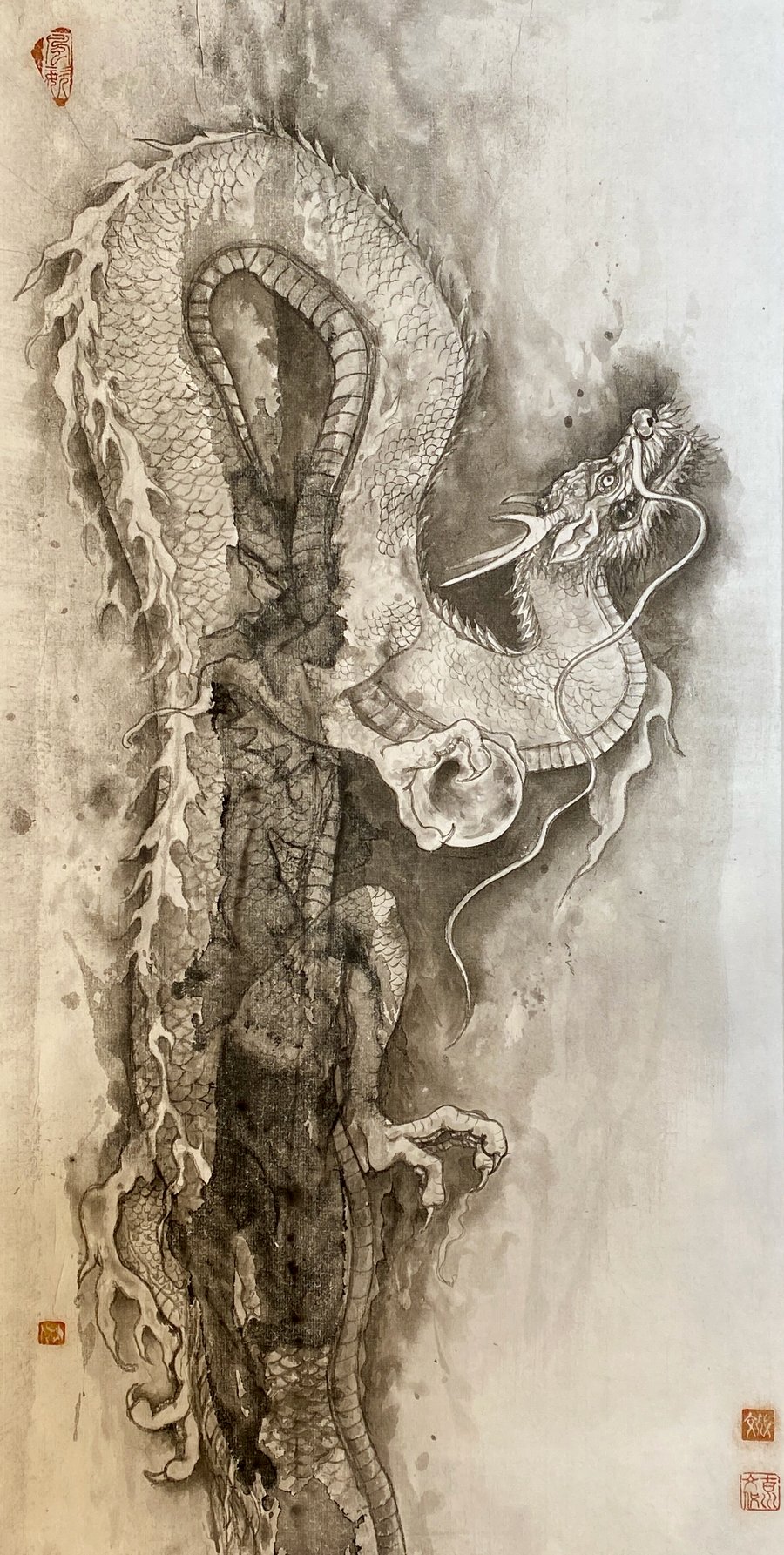
Rising Dragon
龍 — 登る龍
Dragons hold layered significance across many cultures. In Japan they have long been revered as water deities — spirits of waterfalls, rivers, and rain. Their form itself is a composite: the face of a camel, the horns of a deer, a serpent's body, fish scales, tiger's legs, eagle's claws. Some traditions trace the dragon's origins to the crocodile. In Japanese art, from Kanō Tan'yū to Hokusai, the dragon appears again and again in ceiling paintings, fusuma-e, and stone — always distinguished by those catfish-like whiskers drifting in water or cloud.
Thinking about the year of the Dragon, I began working on dragon-themed studies in the autumn of 2023. I accumulated trials and sketches for weeks. Nothing quite resolved. The image I was reaching for kept slipping out of reach.
Then something unexpected happened. An abstract painting I had made roughly two years earlier — left unfinished, buried in a pile — resurfaced. As I looked at it again, a waterfall emerged. And from the waterfall, a dragon rising.
That was the moment of clarity I had been waiting for. Everything that had accumulated through the months of searching suddenly fell into place, and the painting came together at once — as if the earlier work had been holding the answer the whole time.
Sumi ink on Xuan paper · 27 × 13.5 in. · 2023
Work Note · 2016–ongoing
Tenchi Dōkon — Shape of Meditation
天地同根 — 瞑想の形
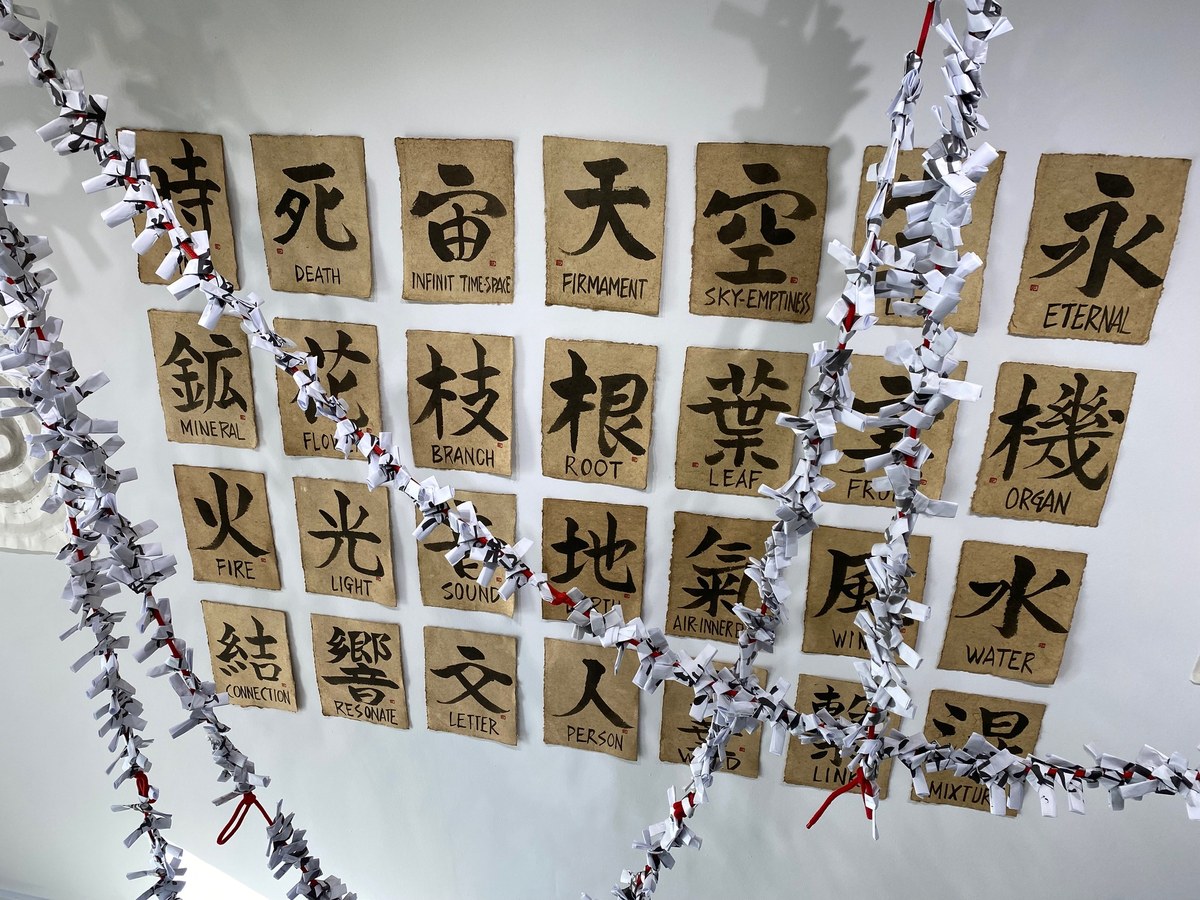
Tenchi Dōkon (a set of calligraphy)
Tenchi Dōkon (天地同根) — "heaven and earth share the same root" — is a phrase drawn from the Zen text Jinanjū, attributed to the Tang master Nansen Fugan. It points to a fundamental unity underlying all things: that the self and the universe, the seen and the unseen, are not separate.
This set of twenty-eight calligraphies explores that concept through the individual characters of the phrase. Each piece is painted on India paper — a single character rendered in sumi ink, slowly, with full attention. Taken together, the twenty-eight works form a complete meditation: not a series, but a set — each piece inseparable from the whole.
Shape of Meditation (installation · 2016–ongoing)
Shape of Meditation is a separate and ongoing installation. Red cotton cord — each length approximately thirty feet, with five to ten lengths used at a time — carries fragments of paper accumulated through the act of making: studies, practice, trial and error, the traces of doubt and discovery that build toward a finished work. Suspended in space, these fragments shift with air, light, and movement, making the quiet process of attention visible. The installation responds to the architecture and atmosphere of each space and continues to grow.
In both works, the act of concentration itself becomes visible — whether in the pressure of a brushstroke or the weight of paper on cord. To sit with a single character until it opens; to hang a piece of paper in the air and let it hold something. This is the practice.
Tenchi Dōkon: sumi ink on India paper · Set of 28 · 2022 · Shape of Meditation: sumi ink on rice paper, cotton cord · 150–900 ft. · 2016–ongoing
Watch documentation video →
Essay · 2024
Akasha — Shared Memory
アカシャ — 共有の記憶
This work is part of my ongoing Akasha series, which explores the possibility that memory and existence are connected through an unseen field.
The series emerged from personal reflections on relationships between generations of women. As a child, I held impressions of my mother that I could not fully understand at the time. Later, after becoming a mother myself, I began to imagine how my daughter might experience the world — and how she might one day remember me. Through this shift in perspective, I gradually came to sense my mother's inner life in ways that had once been invisible to me.
In her later years, when we were able to spend more time together, she sometimes spoke about her own mother, her younger days before marriage, and the people who had shaped her life. Listening to these stories, I began to see her life more fully. In this way, memories of my mother and my own experience as a mother began to overlap across time.
While reflecting on these layered experiences, I encountered the concept of Akasha, described in ancient philosophy as a subtle field that holds the traces of existence. It offered a way of thinking about memory not only as something belonging to a single life, but as something that may quietly resonate across generations.
This perspective also resonates with the concept of Tenchi Dōkon (天地同根) — the understanding that heaven, earth, and all beings share the same root. In Japanese thought, particularly within Shinto tradition, mountains, trees, rocks, the earth itself, and even objects made by human hands are often understood to hold a sacred presence. Life and spirit are not limited to living creatures alone, but are felt as part of a wider, interconnected existence.
Each of these memories might be connected and shared with all the memories in the universe. While painting, I contemplate such possibilities.
The works are created with sumi ink and gold on paper. I begin by allowing ink and water to form spontaneous patterns on the surface. From these formations I gradually draw lines and forms, imagining the flow of time and space unfolding within them. Small areas of gold suggest points of intersection within a vast field — moments where layers of space and time, and perhaps even generations, quietly meet.
Through this process, I seek to evoke a space where individual lives and memories appear distinct, yet remain part of a larger continuum of resonance.
Studio Note · February 7, 2024
Rain, and What It Remembers
雨と、記憶
Today, once again, it has been raining since morning. I decided to take Honey for a walk in the afternoon, trusting the forecast that it would clear up by then. So I settled in early and started work in the studio.
I feel like the series of small pieces I have been gradually preparing for my solo exhibition in Kyoto is starting to take shape. There is a concept in the universe similar to the Zen philosophy of Tenchi Dōkon — everything in heaven and earth sharing the same one root — which suggests that all phenomena are connected to a single source. It is called the Akashic Records, said to store all memories from the past to the present throughout the entire universe. I am painting this series while imagining what shape and color such records would take, if they truly exist.
Speaking of rain — while it is a blessing for drought-stricken California, I worry about the damage if it becomes too severe or turns into a storm. My heartfelt thoughts go out to those affected by such disasters.
Yet as I listen to the sound of rain while pondering the Akashic Records today, memories of my childhood come flooding back.
I loved seeing the concentric circles formed by raindrops hitting the ground, and I loved the unique scent that filled the air when rain wet the asphalt.
Upon reflection, I realize that when I was a child, I enjoyed walking in the rain more for the simple pleasure it brought rather than seeing it as beneficial rainwater. Getting new raincoats, umbrellas, or rain boots was always exciting — it meant I could walk in the rain while wearing them. I loved deliberately stepping into puddles, or listening to the pitter-patter of raindrops hitting my umbrella.
Each of these memories of mine might be connected and shared with all the memories in the universe. While painting, I contemplate such possibilities.